I
His life
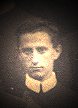
At twenty, as a novice, he wrote the story of his own life and divided it into three periods: “Before my vocation”, “The vocation itself” and “After my vocation”. The first three sections below follow that division. The fourth covers his years as a missionary and superior.
Before my vocationAlaejos, 1873–1886
He was born in Alaejos on 21 March 1873, at six in the evening, in the family home at number 22, Calle Casasnuevas. He was the youngest of the six children of Miguel Jiménez and Brígida Bibiano, who lived, as he himself says, “in fair comfort, esteemed by everyone for their honesty and good conduct”. Four days later he was baptised in the parish of San Pedro Apóstol.
Birth record, Alaejos Civil Registry. Baptismal record, parish of San Pedro. Curriculum vitae of 1893, pp. 2–3.
He was four when his father died, “the principal and, one may say, the only support of the family”. His mother kept the household going with the help of the eldest son, and it was she and one of his sisters who taught him to make the sign of the cross and to ask for a blessing before going to bed. At six he began to go to school, “more to play than to learn, because I was rather mischievous”. Some days he had to be taken there by force.
Curriculum vitae, p. 3.
He was confirmed in San Pedro by the Archbishop of Valladolid, Fernando Blanco y Lorenzo, on 31 October 1879. He made his first communion when he turned ten. That day, after his thanksgiving, he knelt to ask his mother’s forgiveness and went with some other boys to the hermitage of Our Lady of the Casita, a quarter of a league outside the town, “to give thanks to the Most Holy Virgin for the very great blessing I had received a little before”.
Marginal note on the baptismal record. Curriculum vitae, p. 5.
Then came the years he judges harshly. He writes that at thirteen he frequented casinos, billiard halls and dances, and picked up whatever he heard there. He writes with the severity of a novice examining his conscience, but adds something he never gave up: “I believe I never let a day go by without commending myself to Most Holy Mary, and this was my salvation”.
Curriculum vitae, pp. 6–7.
The vocation itselfAlaejos and Nava del Rey, 1887
Early in 1887 two Redemptorist missionaries, Fr Francisco Negro and Fr Pablo Lorthioit, came to Alaejos to preach a fortnight’s mission. “As soon as I saw them I felt something I cannot describe in my heart,” he writes. He did not miss a single exercise, got up early to serve their Masses and followed them everywhere. One day, after pestering Fr Lorthioit for a hymn sheet, he got a slap from him, “but a very affectionate one, followed by the hymn sheet”.
Curriculum vitae, p. 7. Fr Saturnino dates the mission to 1886 (letter of 1944, p. 1).
What moved him most was the evening ceremony of lights, with the sermon Fr Negro preached that day, and the picture of Our Lady of Perpetual Help. After the mission, he says, “I never, or almost never, turned to any other image of Mary”. His friend Saturnino sums it up: he professed “a thoroughly Christian life, openly and proudly devout”. He always wore the four scapulars.
Curriculum vitae, pp. 7 and 9. Letter of Fr Saturnino Martín, pp. 1–2.
His vocation came through a friend, the sacristan of San Pedro, who told him in confidence that he was going to ask to join the Congregation of the Most Holy Redeemer. Thinking it over, Donato said to himself: “What a good vocation he has chosen! Couldn’t I do the same?”. His mother would not hear of it: he was the youngest and was to be “the support and the staff of her old age”. He then began “a completely new life”: every morning he went to church, served as many Masses as he could and prayed his rosary to Our Lady of Perpetual Help, whose picture was displayed on the high altar.
Curriculum vitae, pp. 8–9.
In May, during a novena to Our Lady of the Casita, he heard that the missionaries were coming back to the town and ran out to meet them. At the door of Santa María, Fr Negro said to his companion, Fr Blanpied: “This one wants to come with us”. And the other, taking him by the nose, replied: “So it seems — his nose is ours already”.
Curriculum vitae, pp. 9–10.
Soon afterwards his mother changed her mind: “Most Holy Mary had changed her heart!”. There was no money to pay for his studies, until the fathers sent the archpriest the list of what those who could not pay should bring with them.
Curriculum vitae, p. 10.
The greatest obstacle remained: a stepfather who blasphemed, who forbade him to go to church so often and who, on learning that he wanted to be a religious, “turned into a tiger”. “He told me no, he would not let me. No? I said to him. We shall see.” A good woman advised him: “Have confidence, son, Saint Joseph will help you”. With another boy he made a novena before the saint, with two candles lit, and when it ended his stepfather gave way. From then on Saint Joseph was for him “a true father”.
Curriculum vitae, pp. 11–12.
They were examined at the Redemptorist house in Nava del Rey by Fr Desnoulet, Fr Negro and Fr Blanpied. Fr Saturnino remembered the four questions they had to answer in writing: “who are you, what do you want, why do you wish to come with the Missionary Fathers, and what are you coming for”. All four boys from Alaejos were accepted.
Curriculum vitae, p. 12. Letter of Fr Saturnino, p. 4.
The night of 1 August 1887
The next day was the feast of Saint Alphonsus, founder of the Redemptorists, and that year was the centenary of his death. The four boys did not want to wait. They asked permission at home, took two of the donkeys used to fetch water and carry food to the reapers, rode two to a donkey and set off at nine at night. “It was striking a quarter past eleven when we reached Nava.” The house was shut. They slept on the stones by the door, “sighing for the dawn to come”.
Curriculum vitae, p. 12. Letter of Fr Saturnino, pp. 2–3.
In front of the church lay the embers of the feast-day bonfire. Saturnino, who was one of the four, wrote about it fifty-seven years later: “Those embers were a fitting image of the embers of fervour and enthusiasm burning in their young souls”. At dawn they went to confession to Fr Negro and spent the whole day at the house.
Letter of Fr Saturnino, p. 3. Curriculum vitae, p. 13.
Saturnino kept another memory from one of those visits to Nava. In the church of the Concepción, before the Virgin, Donato picked up a stone and struck his breast with it: “it seemed to me to foreshadow the martyrdom to which God would one day call him”.
Letter of Fr Saturnino, pp. 4–5.
After my vocationEl Espino, Nava del Rey and Astorga, 1887–1899
On 19 September 1887 he left his town and his family. The four who were leaving bet on who would cry first, “and none of us cried”. They got off the train at Pancorbo and reached the juniorate — the Redemptorist minor seminary — at El Espino, in the province of Burgos, where he spent five years. At the end of them he was removed as head boy after complaints from his companions; he writes that he forgives them “with all my heart” and wishes he had borne it better.
Curriculum vitae, pp. 13–15. Saturnino dates their arrival at El Espino to 26 September (letter, p. 5).
He entered the novitiate at Nava del Rey on 12 August 1892. His friend remembers him there as “very neat and tidy in his things and his person”, his cassock “nicely kept, with the pleats well arranged”. To test him against vanity, the novice master made him wear a blue apron for a whole day, “put on at the back and tied at the front”. The parish priest of Nava came in while they were working in the garden: “the rest of us laughed, and Jiménez smiled too”.
Curriculum vitae, p. 15. Letter of Fr Saturnino, p. 7.
In February 1893 he went through a hard interior crisis, which he describes frankly to his novice master and in his account. He came out of it stronger: “The temptations have rooted me firmly in my vocation and have given me great courage and strength to overcome every obstacle placed in my way”. Near the end of his account he makes a promise: “I shall be yours for ever, and I shall remain faithful to you until death”.
Curriculum vitae, pp. 15–16.
He made his profession on 8 September 1893, the same day as Saturnino. He studied theology in Astorga, where he was nearly always sacristan of the oratory, and was ordained priest there on 27 May 1899, in the seminary chapel, by Bishop Vicente Alonso Salgado.
Letter of Fr Saturnino, p. 8. Profile in Testigos de la Redención. Official biography of the cause.
Missionary and superior1899–1936
He spent his first years as a priest in formation work: assistant to the novice master at Nava del Rey and Latin teacher at El Espino. Saturnino says that as a teacher he showed “an extraordinary eagerness to do good to his pupils”. After a second novitiate in 1902 he was a missionary for the rest of his life: in the communities of Cuenca, El Espino and Astorga, and from 1915 in Pamplona, where he lived for fifteen years and was three times rector of San Ignacio.
Profile in Testigos de la Redención. Letter of Fr Saturnino, pp. 8–9. Jenaro Xavier Vallejos also recalls his fifteen years in Pamplona.
Of his preaching we have the portrait drawn by his friend, who read some of his sermons: “His style was popular, an enemy of empty flourishes; his sermons were substantial and carefully prepared”. He had a loud voice and began so forcefully that he ended up hoarse, until Saturnino advised him to moderate it. “Being simple, friendly, kind and very zealous, he won people over completely in the villages.” From the missions he brought several boys to the juniorate who later became missionaries themselves.
Letter of Fr Saturnino, pp. 9–10.
He was superior in Santander from 1930, minister — the superior’s deputy — in Astorga from 1933, and rector of Vigo from December 1934. Saturnino heard a provincial call him “an ideal superior”, and adds on his own account: “having known him as a student and as a priest, I never saw him irritated or out of temper”.
Profile in Testigos de la Redención. Letter of Fr Saturnino, pp. 10–11.
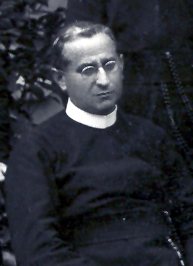
In the appointments of 1936 he was assigned to the community of San Miguel Arcángel, in the La Latina district of Madrid. He arrived on 23 June. He had been in Madrid less than a month when the persecution began.
Profile in Testigos de la Redención. Official biography of the cause.